Attribute
|
Description
|
Values
|
dsi:ascent
|
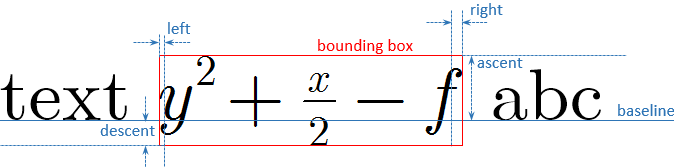
The amount in pixels above the baseline. See figure beneath this table.
|
Distance in pixels
|
dsi:background
|
The background color of the maction element.
|
See MathML spec. MathML 3 allows the use of mathcolor and mathbackground on all presentation elements, so these are less useful now although dsi:background is used with dsi:backgroundstyle
|
dsi:backgroundstyle
|
The style to use for the background
|
- "fill": Fill the background with the
dsi:background color - "frame": Draw a frame around the
maction node using the dsi:background color
|
dsi:color
|
The foreground color of the maction element.
|
See MathML spec. MathML 3 allows the use of mathcolor and mathbackground on all presentation elements.
|
dsi:descent
|
The amount in pixels below the baseline. See figure beneath this table.
|
Distance in pixels
|
dsi:href
|
URL to visit when clicking on an maction element. MathML made href an attribute of all nodes, so this attribute is deprecated.
|
A valid URL
|
dsi:left
|
The left sidebearing -- this is the "extra" amount on the left side of the chars used for drawing; it is typically added to the bounding box of the characters because you don't want one character to start where the last left off.
See figure beneath this table.
|
Distance in pixels
|
dsi:maxtableshrink
|
Valid for <mstyle>, <math>, <mtable>. When tables are too wide to fit in the allowed space, their width is shrunk. This causes some or all of their columns to have their width reduced, causing some entries in those columns to linewrap. At the point where the code figures out that the table needs to be narrower, not all information is known about how much it should shrink because information such as indents and allowable break points are not known. This attribute controls the maximum amount the code will shrink the table by. Eg, if length is "4em", the table will shrink by no more than 4 ems. If length is "20%" (the default), the table will shrink by no more than 20% of the linebreaking width.
|
Length (default: "20%"), where length is any valid length value (in, pt, em) and % is interpreted as being a percent of the line-breaking width at that point.
|
dsi:right
|
The right sidebearing -- this is the "extra" amount on the right side of the chars used for drawing; it is typically added to the bounding box of the characters because you don't want the next character to start before this one leaves off.
See figure beneath this table.
|
Distance in pixels
|
dsi:scriptsatsameheight
|
Valid for <mstyle>, <math>. If true, nested scripts will be positioned at the same height. For example, (x^2 + y^2)^2 will position all of the 2's at same height. This attribute does not affect script positions when the nest expression ends with a character that is tall-stretched. For example, (a/b + y^2)^2 will not position the 2's at the same height.
|
Boolean value (default: false)
|
dsi:useprecomposed
|
Valid for <mstyle>, <math>. Unicode defines the number of characters that can "compose" with the character before it. Typical examples are accent marks on letters. Many fonts include nicely composed letters which will be used when the value is "true." However, if the combining character is being used for mathematical markup, then the pre-composed character will not display as intended.
For example, the Greek capital letter "alpha" (U+0391) composed with the combining acute accent (U+0301) appears as ? (U+0386) in the Greek alphabet and in most fonts. To avoid this, use "false."
This only affects cases where letters and accents are used instead of markup. Note that MathML suggests using markup (e.g., mover) for these cases. If markup is used, "true" (the default) should be used.
|
Boolean value (default: true)
|


![[Design Science Home]](dessci_logo.gif)