Erdogan Insists on Two-State Solution During Visit to Occupied Northern Cyprus

Erdogan Insists on Two-State Solution During Visit to Occupied Northern Cyprus
Turkish President Recep Tayyip Erdogan reaffirmed Saturday his support for a two-state solution to the Cyprus conflict during a visit to the occupied-north of the Mediterranean island.
“The two-state solution is the joint vision of Turkey and northern Cyprus,” Erdogan said referring to the Turkish-occupied north, recognized only by Turkey as an independent state, saying it “will exist forever with the support of guarantor Turkey.”
“Any new negotiation process must be between two sovereign states,” he added.
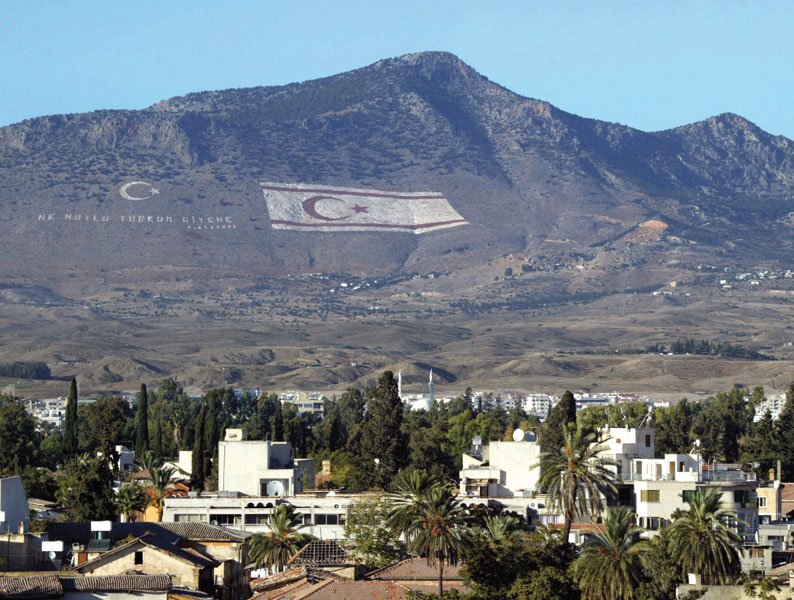
The Turkish President visited the occupied-north of Cyprus for the TEKNOFEST exhibition, while he also attended the inauguration of a government complex in the northern part of Nicosia, Cyprus’ divided capital, built by Ankara and including a new presidential palace and parliament building.
Erdogan rejected renewed talks with the Republic of Cyprus.
“Until a solution that reflects the realities of the island is reached, we will not engage or trade with the Greek Cypriot Administration,” he said during a speech at the opening of the building.
He also accused the Greek Cypriot leadership of maintaining an “arrogant mindset” that refuses to recognize Turkish Cypriots as equals.
“No one can make Turkish Cypriots pay the price for the lack of a solution,” Erdogan said.
Cyprus was divided in 1974 when Turkey invaded the island following a coup backed by Greece, which was under a military dictatorship at the time. Turkey illegally occupies the island’s northern third, where it maintains more than 35,000 troops.

Years of deadlock in longstanding Cyprus issue ended in March 2025
In March 2025, UN Secretary-General Antonio Guterres hosted in Geneva informal talks with Cyprus’s President Nikos Christodoulides, Turkish Cypriot leader Ersin Tatar, and representatives of the guarantor powers, Greece, Turkey, and the UK.
The discussions did not lead to a resolution of the Cyprus issue. However, the participants agreed on a set of confidence-building measures and decided to continue the talks in the summer.
After eight years of deadlock, this was the best possible outcome, analysts said. After the meeting, Guterres commented: “It is important to note that even before Crans Montana, and we are talking about 2017 until now, there was no real progress on any aspect and today there was meaningful progress.” The bar had not been placed very high, but even a little progress, after eight years of none, is something.”
Christodoulides said he wished to “express satisfaction” with the result of the meeting, describing it as “a first important, positive step towards the resumption of talks.”
“This is the big goal, we are not there yet, but, as [Guterres] himself said, it has been an important step,” he said. He added that the “great effort is of course not complete today” and that it only constitutes the start, saying his government “has a plan for how we will continue this course”.
Earlier, Tatar had given a brief press conference, stressing the importance of “resolving the problems experienced in relations between the two communities and establishing a culture of cooperation”.
“Turkish Cypriots and Greek Cypriots deserve much better. We must find a sustainable solution for both our children and future generations,” he said.
Six confidence-building measures were agreed in Geneva. There will be the opening of four crossing points, with each side proposing two, de-mining, the establishment of a technical committee on youth, initiatives on the environment and climate change, photovoltaics in the buffer zone and restoration of cemeteries.