Mysterious Undeciphered Languages That Still Baffle Experts

Mysterious Undeciphered Languages That Still Baffle Experts
Despite advances in technology and artificial intelligence, a number of mysterious undeciphered languages from ancient civilizations continue to puzzle scholars.
These writing systems, left behind on stone tablets, seals, and pottery shards, offer glimpses into once-thriving cultures whose voices remain silent due to the inability to decode their scripts.
Experts like Svenja Bonmann, a historical-comparative linguist at the University of Cologne, work to reconstruct such ancient languages.
Ancient scripts that resist decoding
Bonmann studies the Epi-Olmec script from Mexico’s southern coast. Although some inscriptions suggest the presence of early writing, the limited number of texts and lack of context make the system exceptionally hard to interpret.
Other examples include the Indus Valley script, found in what is now India and Pakistan. Despite appearing on hundreds of artifacts, the symbols are short and offer no clear sign of grammatical structure. Whether they represent a full language or a system of symbols is still under debate.

Easter Island’s Rongorongo script adds to the challenge. Its glyphs depict birds, humans, and decorative shapes, but only a few wooden tablets survive, many of them damaged. Similarly, the Minoan civilization of Crete left behind three writing systems.
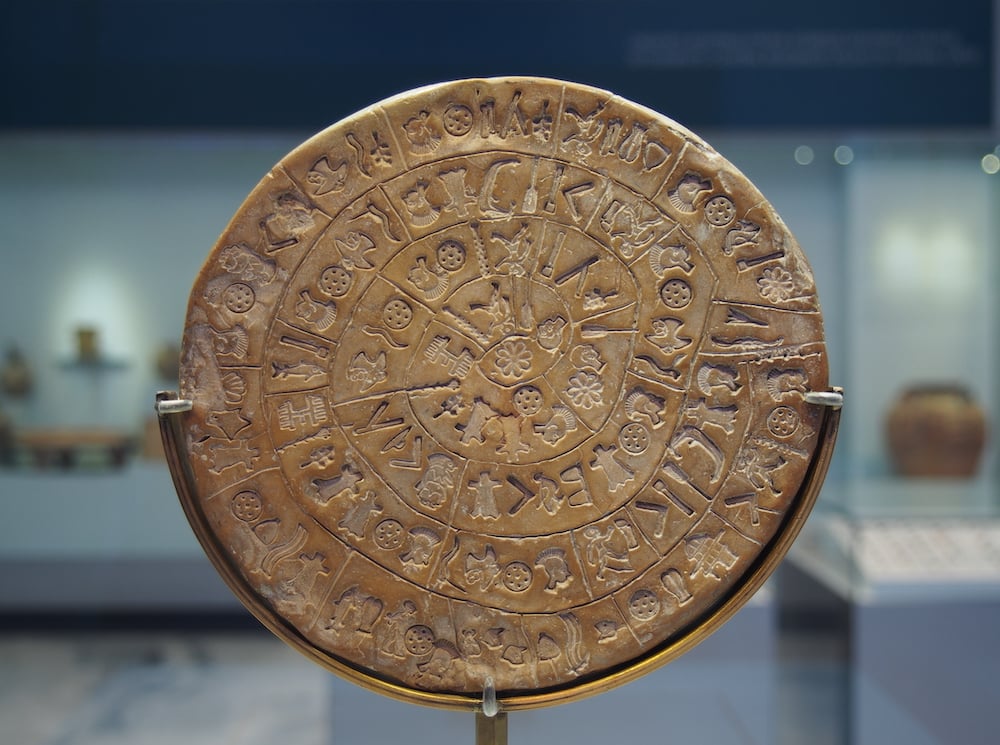
Only Linear B, an early Greek form, has been deciphered. The others, Linear A and Cretan Hieroglyphic, remain unreadable. The Phaistos Disc, dating back to around 1700 B.C., is one of the most notable artifacts from this era. With its spiral symbols and singular nature, it continues to defy interpretation.
Why some languages remain a mystery
The Etruscan language of central Italy also remains largely unknown. While the script, derived from Greek, is legible, the language itself lacks close relatives, making its meaning difficult to uncover.
In modern-day Iran, the Proto-Elamite system is considered the earliest known writing from the region. Despite a well-documented set of signs, its fragmented administrative records and lack of links to known language families complicate efforts to decipher it.
One of the biggest obstacles is the absence of a bilingual key like the Rosetta Stone, which helped decode Egyptian hieroglyphs. Bonmann explained that without such a reference, it’s difficult to match symbols with sounds or words. However, she said deciphering is still possible if researchers can find links to names of places, rulers, or deities from later historical records.
Bonmann noted that artificial intelligence, though increasingly used in this field, struggles with small datasets. She emphasized that AI mimics reasoning by rearranging known words rather than generating original insight, which can lead to misleading conclusions.
For Bonmann, the effort to uncover how past societies communicated is central to understanding what it means to be human.