The Ancient Libraries Buried in the Sand for Millennia

The Ancient Libraries Buried in the Sand for Millennia
Underneath the sands of the Near East, Egypt, and Central Asia, ancient libraries preserving vast troves of knowledge and wisdom have been uncovered, long buried beneath sand or sealed in caves for centuries.
Recorded knowledge on clay tablets, papyrus scrolls, and parchment manuscripts preserved in libraries and public offices has resurfaced, safeguarding myths, records, laws, stories, scientific observations, battle accounts, philosophical reflections, and a wealth of other information. Yet countless archives have been lost over time due to wars, natural disasters, plundering, and the relentless passage of centuries.
Today, some of these hidden treasures have been recovered, offering glimpses into humanity’s brilliant—and sometimes dark—past. It is as if voices from a distant era are speaking once more, telling their stories.
The deserts of the Near East, Egypt, and Central Asia have proven particularly fertile for such discoveries. Arid environments often preserve organic materials that would decay rapidly in humid climates. In regions where moisture is scarce, items like papyrus, parchment, and cloth can endure for centuries, surviving where they would otherwise rot.
Excavations across these deserts have revealed astonishing caches of texts that illuminate lost intellectual worlds. These buried ancient libraries remind us that knowledge was highly valued long before the modern era and that entire traditions of thought once flourished in places now reduced to ruins.
The ancient buried library of Ashurbanipal
One of the earliest and most remarkable discoveries of an ancient library occurred in the mid-19th century at Nineveh, in present-day Iraq. Excavations from 1851 to 1932 at the palace of the Assyrian king Ashurbanipal uncovered approximately thirty thousand clay tablets inscribed with cuneiform writing. Dating to the 7th century BC, this royal collection included literary works, administrative records, scholarly treatises, and religious texts. Among them was the Epic of Gilgamesh, one of the oldest surviving works of literature.
The tablets had been hardened by the fires that destroyed Nineveh in 612 BC. Ironically, the very catastrophe that ended the Assyrian Empire also preserved its literary legacy. When archaeologists unearthed the tablets beneath the ruins, they discovered a carefully organized archive. Many texts bore colophons indicating their titles and the order of the series to which they belonged, suggesting that the Assyrians had developed systematic cataloging methods for their ancient library.
Historian Marc Van De Mieroop notes that Ashurbanipal’s collection represented an effort to gather knowledge from across Mesopotamia. “The king saw himself not only as a ruler, but as the custodian of the intellectual traditions of Babylonia,” he writes. Many of the tablets were copied from older sources, indicating that the Assyrians were preserving texts that were already ancient in their own time. These documents, nearly three millennia old, have profoundly shaped modern understanding of Mesopotamian culture and literature.
Coptic manuscripts in Nag Hammadi
In 1945, in the desert near the village of Nag Hammadi in Egypt, farmers digging for fertilizer uncovered a sealed jar containing thirteen leather-bound codices. Written in the Coptic language and dating to the 4th century AD, these manuscripts belonged to the early Christian community, which utilized a modified Greek alphabet. The codices contained over fifty previously unknown texts linked to early Christian and Gnostic traditions.
Before this discovery, most knowledge of Gnostic beliefs came from the writings of their opponents—the early Christian Church Fathers of the 2nd to 4th centuries AD—who considered Gnostics heretics. The Nag Hammadi ancient library provided direct evidence of the theological diversity that existed in early Christianity. Texts such as the Gospel of Thomas and the Gospel of Philip offered alternative interpretations of Jesus’ teachings and the nature of salvation.
Historian Elaine Pagels highlights the significance of this find for understanding the early Christian world: “The Nag Hammadi texts reveal that what we call Christianity once included a far wider range of ideas than later orthodoxy allowed.” The manuscripts were likely hidden by monks seeking to protect them from destruction after church authorities condemned Gnostic writings. Buried in the Egyptian desert, the codices remained untouched for more than fifteen centuries until their chance discovery.
The library caves of Dunhuang
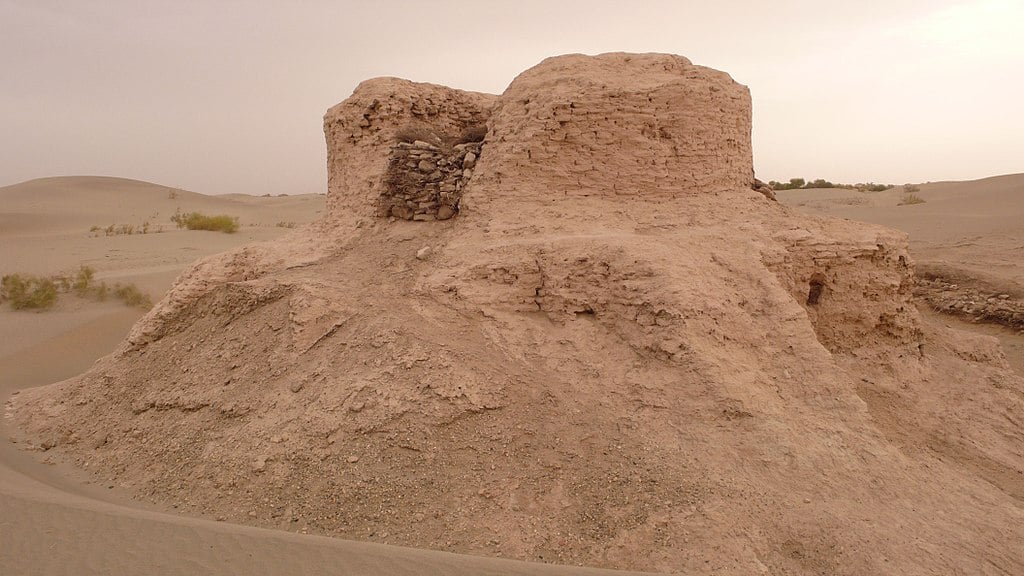
In Central Asia, the sands of the Taklamakan Desert concealed another extraordinary archive: the ancient library caves of Dunhuang. Though not buried in the same way as a collapsed ruin, the manuscripts were sealed behind a wall in a cave shrine around the 11th century. When the hidden chamber was rediscovered in 1900, it contained tens of thousands of manuscripts and paintings dating from the 4th to the 11th centuries.
The texts were written in multiple languages, including Chinese, Tibetan, Sanskrit, and Sogdian, reflecting the cosmopolitan character of the Silk Road. Buddhist scriptures made up the majority of the collection, but the archive also included administrative records, medical texts, contracts, and even personal letters. These findings offer invaluable insights into daily life along the trade routes connecting East and West.
Professor Susan Whitfield, an expert in Silk Road history, describes the Dunhuang manuscripts as “a time capsule of medieval Eurasia.” She emphasizes that the documents reveal the movement of ideas across vast distances, showing how religions, technologies, and artistic styles circulated along the Silk Road. Like the tablets of Nineveh and the codices of Nag Hammadi, these manuscripts survived precisely because they were hidden and forgotten.
The Oxyrhynchus papyri
Egypt’s desert climate is ideal for preserving ancient materials such as papyrus and parchment, which would normally deteriorate quickly in humid conditions. At sites like Oxyrhynchus, these materials have survived for centuries, and archaeologists have recovered enormous quantities of documents from ancient garbage dumps buried beneath the sand. What initially appeared to be a simple landfill revealed itself as a kind of ancient buried library, containing literary fragments, tax records, private correspondence, and official decrees.
English papyrologist Bernard P. Grenfell once noted that Egypt’s sands preserved “the everyday voices of antiquity.” Among the Oxyrhynchus finds were fragments ranging from lost plays by Sophocles and Euripides to early copies of Christian scriptures. The documents were primarily in Greek, dating from the 2nd century BC to the 7th century AD, with additional texts in Latin, Demotic, Coptic, and Arabic.
These discoveries demonstrate the vast scope of ancient literature that once existed, far beyond the limited canon that survived through medieval manuscript traditions.
The ancient buried Qasr Ibrim manuscripts and the Timbuktu findings
In modern-day Ethiopia, approximately 250,000 manuscripts have been unearthed at the southern Egyptian site of Qasr Ibrim. These include thousands of documents from the medieval Sudanese empire of Makuria, written in eight different languages. Most of the Arabic texts are documentary in nature, relating to diplomacy and commerce and can be dated throughout the Islamic period. Thousands more manuscripts have survived in West African cities such as Chinguetti, Walata, Oudane, Kano, and Agadez.
Despite the many threats posed by fire, floods, insects, and pillaging, roughly one million manuscripts have endured from the northern fringes of Guinea and Ghana to the shores of the Mediterranean. National Geographic estimates that 700,000 manuscripts survive in Timbuktu, a major center of African scholarship. These documents date back to at least the 14th century and cover subjects such as art, medicine, philosophy, and science, forming an extensive and invaluable ancient library.
Significance of the buried ancient libraries
The rediscovery of these archives within buried ancient libraries has often required painstaking work. Clay tablets must be carefully cleaned and cataloged. Fragmentary manuscripts must be reconstructed like intricate puzzles. Long-forgotten languages must be deciphered before the texts can be fully understood—a process that can take decades or even generations of scholarship.
The importance of these findings, however, is immense. The Epic of Gilgamesh, once unknown to modern readers, has become a cornerstone of world literature. The Nag Hammadi texts have reshaped discussions on the origins of Christian theology, while the Dunhuang manuscripts have illuminated the complex cultural networks of medieval Asia and its connections to the Near East.
Archaeologist David Damrosch observes: “Every buried library reminds us that the surviving record of human thought is only a fraction of what once existed.”